
Jesus the Disciple Maker
Follow Me
Matthew could hardly believe his ears.
"Follow me" wasn't what he was used to hearing. What people usually said to him was, "Why are you following me? Stop following me! Get away from me!"
Matthew was shunned by most people as a traitor, yet as a tax-collector he had some power, and more importantly, powerful friends in the form of Roman soldiers. Therefore, people left him alone, and kept their distance. Many feared him as much as they loathed him.
Perhaps that's why he was so unready for Jesus' invitation to follow Him. There had been no conversation, just an invite, but when he stood at a distance, listening to Jesus teach, he kept feeling that Jesus was staring straight at him. Matthew wondered now if Jesus somehow had known that he was in agony since the last time he'd listened. Jesus had been teaching about the Kingdom of God, and it tore him up inside. Matthew had sold his soul to the Roman Empire already, but something about Jesus' teaching made it sound like anyone could become a part of God's kingdom. Maybe even someone like him.
Matthew knew what kind of man he was. He loved money, security, and the privileges that his position had gained him. All he had to do to secure it was to sell out to the Romans and be willing to sell his own people. Previously Matthew felt privileged to have calculated the costs and done the math in his head that gained him more than he had ever lost, but now he felt trapped, and cheated. He knew he'd made a mistake. He nearly burst into tears when Jesus had said, "What does it profit a man if he gains the whole world, but loses his only soul?" It had been Matthew's worst fear put into words. Now, Matthew would give it all up if only he could have his soul back. But what he'd done was written in ink as permanent as the records he kept for the Romans. Nothing could alter his situation.
But why did Matthew have the slightest glimmer of hope every time he braved the crowds to catch the smatterings of Jesus' words? Hope was for suckers, so Matthew kept shutting it in the box where he kept all the jeers, insults, and abuse he suffered from others to keep himself from feeling anything anymore.
Yet every time Matthew heard Jesus speaking, it reminded Matthew of that deep longing he had in his soul for a relationship with his creator; something left over form his boyhood in the synagogue that Matthew thought he had strangled years ago. Matthew wasn't just a traitor to his people, he had also betrayed his God, and ultimately, himself.
Then why had Jesus just said, "Follow me?"
For the first time since he could remember, Matthew felt like there was someone who not only wanted him around, but actually wanted to spend time with him. This gave birth to a new feeling...an even rarer feeling. Hope. He hadn't known what hope felt like for many years, and the tears welled up in his eyes as he paused for a split-second, still trying to convince himself that this was really happening – that it wasn't just another daydream to pass the hours.
Matthew snapped out of it. It was a no-brainer. A shrewd businessman, he knew an opportunity when he saw it; he immediately left his tax collector booth and followed Jesus, not caring what it would cost him for the rest of his life.
Matthew knew that second chances, like money, doesn't grow on trees.
I Know What I Don't Know
Just over two years later, Matthew stood with the other ten disciples looking up as Jesus was airlifted to heaven before their eyes. Jesus told them that their new assignment was to spread out into all the world, "Go into all the world, making disciples, baptizing them in the name of the Father, Son, and Holy Spirit, teaching them to obey all that I've commanded you, and surely I will be with you until the end of the age" (Matthew 28:19-20).
Matthew understood that he'd be doing for others what was done for him. He would be making invites from Jesus to follow him. He'd seen Jesus shock multiple people like himself by giving the same invitation. In that sense, before Jesus said these words, Matthew already knew the how before he knew the what. Jesus had modeled disciple making for three years, and Matthew learned how to do it by following Jesus.
But that's not how it works today. Most people know what. They've read The Great Commission in Matthew 28, and they understand what Jesus wants us to do. "Make disciples." They just don't know how.
Unfortunately, most churches aren't the place to learn either. That's because most pastors were never discipled themselves. And I have a theory: We tend to disciple the way that we ourselves were discipled.
Which means: We also tend to NOT disciple when we ourselves were NOT discipled.
The Discipleship Pattern of Jesus
The reason that discipleship isn't frequently practiced is that, although the average Christian knows we should disciple, they just don't know how. Yet, there is a pattern of discipleship for us to follow, clearly embedded within the pages of the New Testament. So, how have we missed this?
If the body of Christ had a health textbook, the chapter on the respiratory system would be about the Holy Spirit, but the chapter on the circulatory system? Discipleship. In the same way that the blood carries the oxygen to the rest of the body’s tissues, so the transforming power of the Holy Spirit flows more powerfully and is carried through the practice of discipleship than anything else. Jesus took a bunch of recruits and trained them into gospel commandos because transformation happens in community more powerfully than anywhere else.
Think about it. Jesus spent the bulk of his limited public ministry pouring himself into twelve people for three years, demonstrating the priority of discipleship. Even when we see him preaching and doing miracles, it was largely for the benefit of the twelve who were watching and, often, participating. He included them in the miracles, exorcisms, healings, and mission of gospel saturation. They were apprenticing, in order to “do greater things than you have seen me do” (John 14:12). Jesus discipled them on mission by taking them with him. He gave them hands-on-training experience.
So how do we strategically disciple people on mission today, like Jesus did?
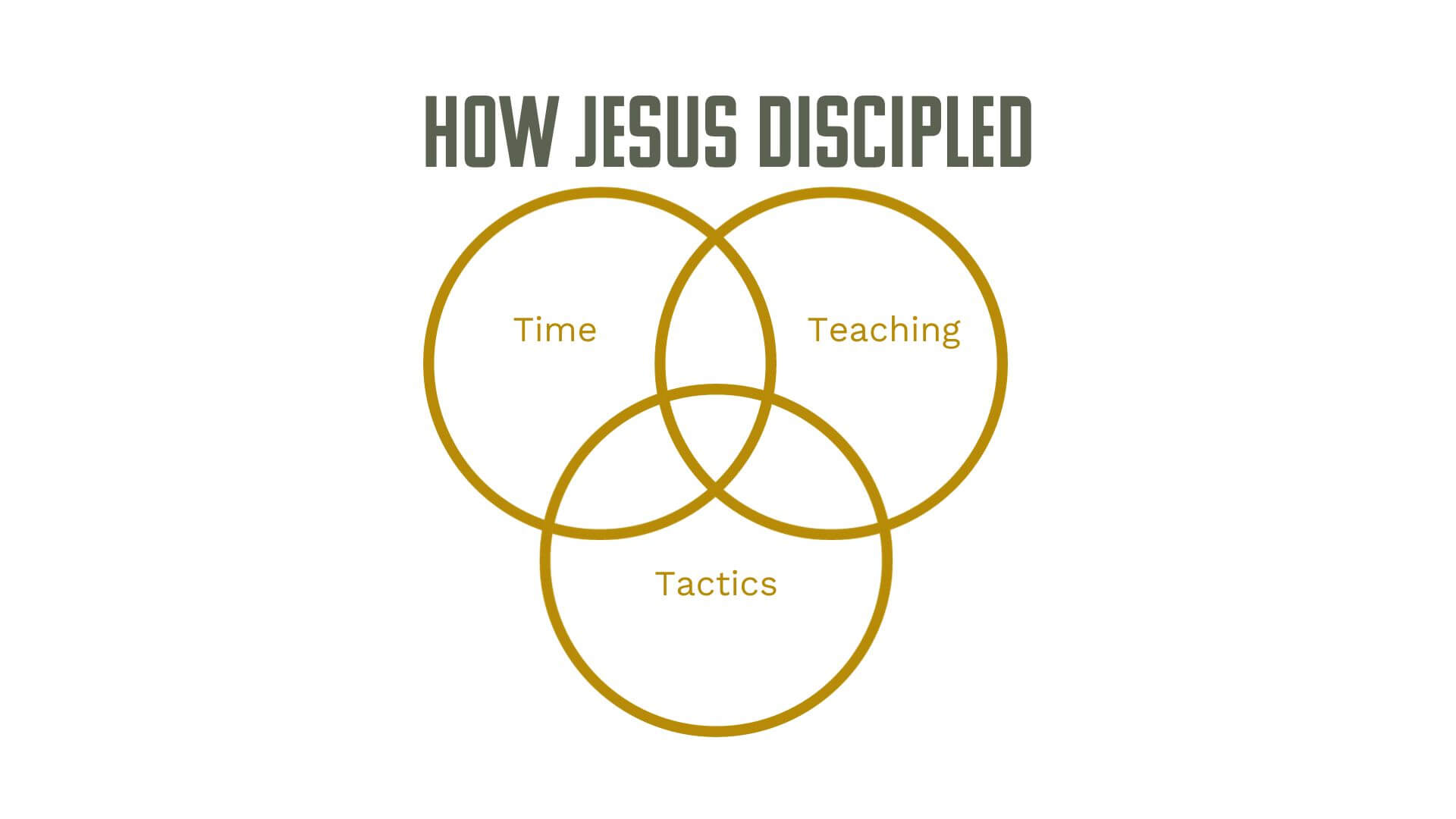
There were three elements of Jesus's discipleship strategy:
- Time
- Teaching
- Tactics
Most of us grew up in churches where teaching was the "means of discipleship" and whenever believers gathered to read a book, or talk over concepts it was mislabeled "discipleship." It was an element of it. But it wasn't the whole bag.
Over the years, we've seen various incarnations of "the missional movement" which emphasized the time element. Within that movement you'll hear phrases like, "we don't go to church; we are the church" or, "let's do life together" as they host barbecues and eat dinner as families. Those who sat in that chair for a while, felt like Goldilocks, noting that it wasn't "just right."
That's because of the third circle: tactical mission. It's very rare that any of our discipleship approaches ever incorporate mission as part of the discipleship strategy. When they do, it's in the form of a short-term mission during a summer, but not really a consistent lifestyle or way of doing ministry. Youth who embark on short-term missions come back changed, and catalyzed, but soon wander away from church, having once tasted the exhilarating aspect of making disciples on the ground.
Each circle runs the danger of prioritizing its own sphere over and above the others, but the perfect blend was accomplished by Jesus, and should be aimed for by modern disciple makers.
Let's talk about how Jesus used each circle to facilitate transformation.
Teaching
Teaching is what forms our thoughts. Changes our minds. Renews how we think. The term "metanoia" is at the root of our word for repentance, which is why people often tell us it means literally to "change our mind." Right thinking leads to right living. Bad thinking leads to bad living. This is where transformation takes place. For our lives to change, our thoughts must change first, and this takes a wisdom greater than our own. For this, we need the supernatural wisdom of God found in His word. This is why Paul says, "Do not be conformed to this world. But be transformed, by the renewing of your mind..." Jesus constantly taught his disciples, seeking to blow apart their paradigms, and turn their thinking inside out. He wanted to wreck them in a good way.
Time
Jesus spent three years, 24/7 with the same group of people. Talk about an investment into others! Jesus practiced what some call “life on life.”
Time is a higher investment than teaching, because it takes...well, more time, but time yields the greatest transformation in someone's life. Spending time with someone provides the secret sauce to transformation because it allows us to model behaviors, and situational leadership for others in everyday experiences.
Tactics
You can’t teach somebody how to fly a rocket on cardboard controls. To this end, Jesus didn't feed the 5000. He had his disciples do it, shocking them by saying, “You give them something to eat.” As they passed out the bread, the miracle literally multiplied out of their hands, making them the dispensers of the miracle the Father performed. This is the process that Jesus wants all of us to take part in, letting God use and work through us in ways we never thought possible. This is why Jesus constantly pushed the disciples to be more than merely deep thinkers or people who talk about things they never do. The day that I turned my team loose in an urban park to share Jesus with others instead of attending another open-air service was the day that they truly began to become disciples of Jesus. They didn’t just say what he said; they began to do what he did.
All three of these must be present for us to truly transform into the disciples that Jesus was making the 12. The disciple who only spends time in teaching will become a know-it-all Christian who does nothing to lift a finger to reach or help those around him. The disciple who only goes out on mission eventually burns out as the gas in their tank runs out, and they crash and burn after running so long on fumes. The person who only spends time with believers becomes the “hostess with the mostest” but runs the best cookout nobody ever came to...or heard the gospel at.
Don't Make Disciples, Make Disciple Makers
Before we close, it's important to think about one more thing. You have not discipled people effectively if their discipleship stops with themselves as recipients. They in turn must disciple others to be a fully formed disciple. Paul told Timothy to “train able people who are able to train others.” In other words, when we train you, you need to train someone else, and when you train them, they need to train others for it to be legit discipleship.
Did you catch it in that verse? There are four generations of disciples present in Paul telling Timothy “train able people who are able to train others.”
Paul: Wave 1
Timothy: Wave 2
Able people: Wave 3
Others: Wave 4
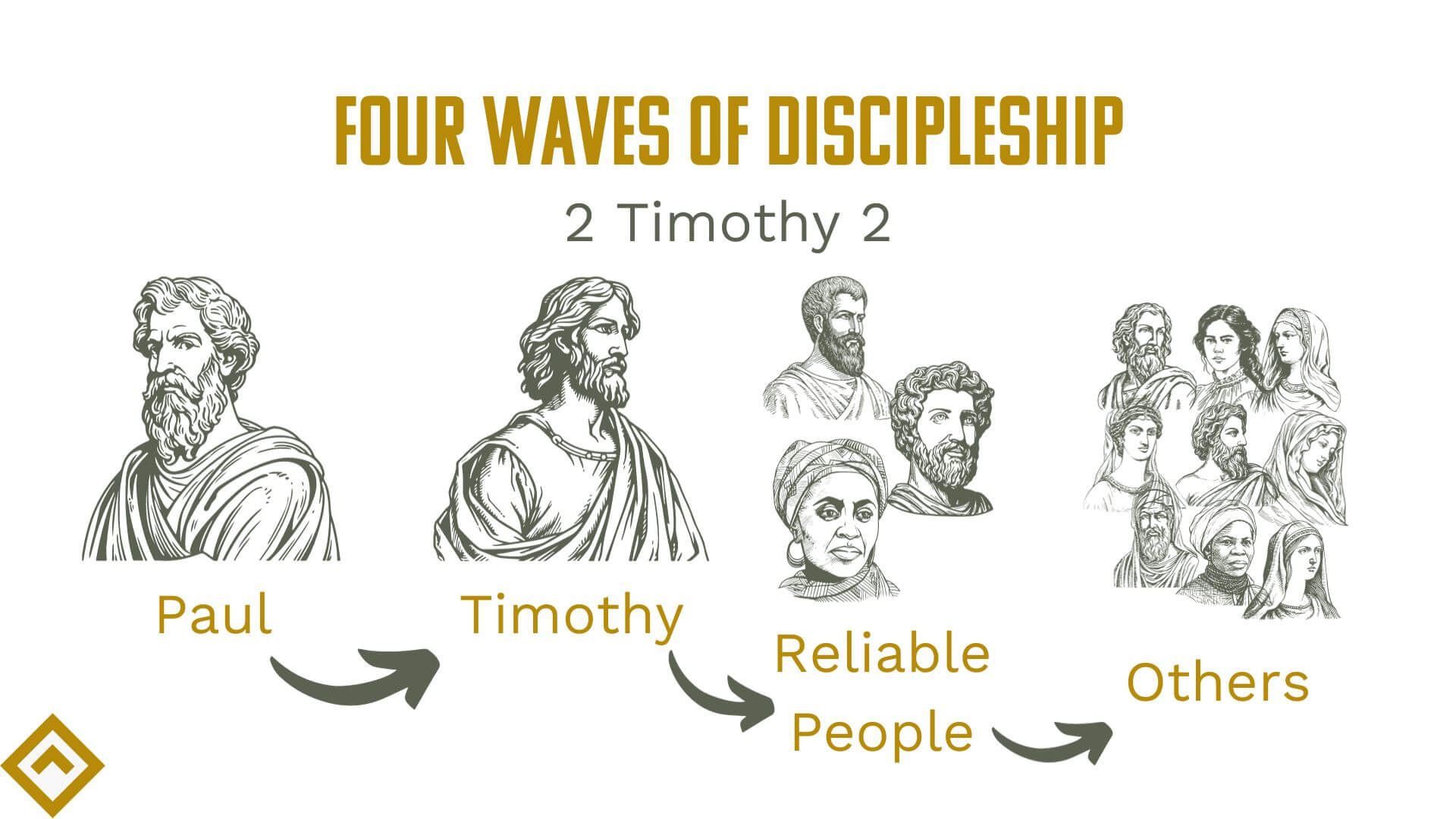
This is why we would tell you not to aim at making disciples, but making disciple makers (or reproducing yourself). If your message isn't "greater things than I've done, you will do" then you've missed the point of discipleship. Disciples must be invited to invite others to know Jesus in order to fulfill the Great Commission. Looking at the outcome in the Book of Acts, we discover the goal of what Jesus was preparing them for. Jesus saw something in them that nobody else did, and poured into them so that they could become powerhouses of multiplication.
I think Jesus sees that in everyone. Including you.
You see, Jesus didn't wait for leaders to emerge; he made his own leaders. And get this; he poured into the people that nobody else saw potential in as his disciples. After spending three years discipling them, that dirty dozen of motley crew rejects turned the world upside down. I had to learn this the hard way. When I watched a show called Kung-Fu as a kid, it centered around a Shaolin monk who trained in the monastery under his master. Each time he would face a challenging circumstance, he would flash back in his mind to a failure that turned into a transformative lesson. Get ready for a kung-fu flashback because my transformative lesson about making disciples came to me when I was planting churches in Long Beach, California. After planting multiple churches, I was running out of leaders fast. The problem was that I was trying to leave the hub in Long Beach and go plant another one somewhere else. Like George Bailey, I just wanted to get the heck out of Bedford Falls. That’s no easy task when you repeatedly send out your best people out to plant a new church.
My transformative lesson of failure came with the threat of being hopelessly trapped without more disciple makers to hand off to. So I asked God what to do. The answer was so simple, that I’m embarrassed to share it. Disclaimer: No brilliance exists in the next few sentences.
I felt that I was being led to simply disciple the people directly in front of me to the best of my ability (and not a single one of them were what we’d consider ministry candidates). If we were picking “ministry hopefuls” like players for a soccer team, they’d all have been picked last. Nobody would have considered them as discipling material but they (and I) would be very wrong. Nevertheless, I obediently started discipling those in front of me, despite their apparent lack potential.
And those people are still reproducing themselves to this day.
I’ve found that more often than not, the people we call leaders are really just people who were discipled well.
Trust me, in the kingdom of God, greatness doesn't mean being awesome at something. All you need for greatness according to Jesus, is to be the servant of all. If you desire to serve others by inviting them to Jesus, and into your own life, in that middle space of discipleship where the circles overlap, then you're ready to make disciples.
Reflection: When They Saw the Courage
Okay, time to make it personal. In Acts 4, the rulers, the elders and the teachers of the law brought Peter and John before them, and after the two of them spoke, everyone was astonished that they were in leadership.
"When they saw the courage of Peter and John and realized that they were unschooled, ordinary men, they were astonished and they took note that these men had been with Jesus." (Acts 4:13)
Why do you think Jesus chose unschooled, ordinary men to disciple?
Jesus didn't change the fact that Peter and John were unschooled and ordinary. What do you think changed about them?
How does this change how you view the people you are, or might be in the future, discipling?
Further Reading
Ordinary Discipleship by Jessie Cruickshank
Eats with Sinners by Arron Chambers