Teaching Strategically
by Brooks Hamon

Imparting Biblical Knowledge
One of the central functions of the Church is to make the Word of God understandable and applicable for the everyday Christian. The Bible is a mirror that shows us our need for salvation and repentance, a lamp that guides us toward sanctification, and provides a framework for using our testimony and knowledge in expanding the Kingdom. Paul wrote to the Church in Ephesus that the Bible is the sword of the Spirit – the only offensive component of the armor of God (Ephesians 4:17). Without the sword, the people in our churches are at a great disadvantage as they go out into the world.
Despite the importance of biblical knowledge, I believe we most often focus on the paths of least resistance…to the detriment of our disciples. Let me start by speaking for myself. Whenever I’m helping someone – usually a high school student – take their first steps through the Bible, I gravitate towards “the easy” books. The ones that seem straightforward. Usually Luke-Acts, some of the Epistles, and Genesis. And I think that, typically, church leaders gravitate towards preaching about the same things. We like to tell the stories of Jesus, Paul, and the Patriarchs. We wear those pages of the Bible out.
The best part is, we get results. I’m quite pleased with myself whenever someone recognizes the same verses in a sermon that we’ve been reading together. Or when they can recall a passage that can be applied to their current situation. So this reinforces the idea that my hard work has paid off and I’ve been focusing on the right things. Except, that might not always be true.
Survivorship Bias
Now, bear with me for a minute because I want to tell a short story from World War II. In the middle of the war, the United States leaned on a collection of scientists in a newly formed Statistical Research Group to explore ways of improving technology and tactics. Sounds exciting right? One of the projects they took up was to help design better bomber aircraft. In order to drop bombs with any accuracy, the airplanes needed to basically become sitting ducks and fly straight at relatively low altitudes. So the group started mapping out where planes were being hit as they returned to base.
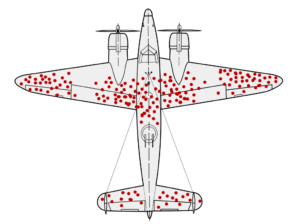
Credit: McGeddon
As they collected data, they noticed that most of the bullet holes were in the wings and tail of the aircrafts. So naturally, the group decided that reinforcing the planes’ armor in those areas would make them safer to operate and ensure a better chance of survival. And they nearly followed through with that assumption until a Hungarian scientist, Abraham Wald, stopped them. The problem was survivorship bias. In reality, the engines and cockpit needed to be reinforced because the planes being hit there didn’t make it back safely.
Could we be committing the same mistakes in the Church?
Strengthening Our Armor
I think what often happens is we teach the parts of the Bible that people can most easily understand on their own. Subsequently we neglect the parts that trip people up. When was the last time someone told you their favorite Bible verse was from Revelation or 2 Kings? Or when did someone mention how what they read in Ezekiel encouraged them in a challenging situation? Maybe those are exactly the parts that church leaders should spend the most time on. Maybe we need to strengthen the armored plating in those areas.
Now don’t misunderstand me. It’s clear that all scripture is useful (2 Timothy 3). I’m not proposing that we neglect the Gospels, or anything else for that matter. What I am saying is that we should pay attention to what people need the most help with.
One of my favorite professors in college was a history professor (I know, surprise) from Spain. She minimized the amount of lecture time in class and used our time together to answer questions and provide insight that she was uniquely suited for. Every few weeks, an entire class period would be devoted to discussing a book we were all supposed to read. You only got credit by participating in the discussion. She didn’t waste her time lecturing on what we could read for ourselves. Instead, she allowed us to explain what we were learning and would chime in to reinforce an idea or challenge our line of thinking. I think I learned more in a day of discussion than I would have in a semester of lectures.
The same principle that Abraham Wald applied is the same one that my history professor used. They paid more attention to what was not there than what was in front of them. Then, they used their energy to strengthen what was weak. There’s a lot of ways we could apply this in a church setting, but I think the most important is that we learn to listen for the gaps in people’s biblical knowledge and then seek to fill them. Let people learn what they can on their own and use your talents to shed light on the rest.
Get Equipped to Impart the Right Things
At NewBreed, we want to give you the tools to use your talents in the most strategic ways. When you join our community, you get access to a new course and exclusive strategy meeting with our team every month that will help you leverage your gifts to empower others on mission. We spend our time determining where your armored plating needs to be reinforced so that you can do the same for the people in your church. To join the community, sign up here.
Brooks Hamon is the Content Director for NewBreed Training. He lives in Wilmington, North Carolina and has been involved in many types of church plants, from micro to mega churches. Before joining NewBreed, Brooks served church planters at Exponential, creating resources and organizing events for like-minded leaders.